
Beyond the Cheat Sheet: Why Your Search for Crossword Jam Answers Is Ruining the Fun (And How to Truly Win)

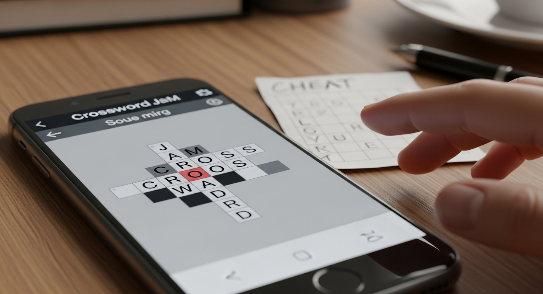
You’re here because of a specific feeling. It’s the quiet frustration of staring at a jumble of letters on your screen—perhaps on the train home, during a coffee break, or while winding down for the night. You’ve swiped every combination you can think of. You’ve found the three-letter words, the four-letter words, maybe even a five-letter one. But that final, long word remains elusive, a ghost in the machine, locking you out of the satisfaction of completing the level. Your thumb hovers over the home button, your mind already typing “Crossword Jam answers level 1247” into a search bar.
Stop.
As a digital strategist and content expert who has spent years analyzing user behavior, I can tell you that this search query is one of the most common for mobile puzzle games. It’s a natural impulse. But I’m also here to tell you, as a long-time puzzle enthusiast, that it’s the single biggest mistake you can make.
The endless lists of Crossword Jam answers online are not a solution; they are a trap. They offer a hollow victory that robs you of the very thing your brain craves: the electrifying ‘aha!’ moment of discovery. The real secret to mastering Crossword Jam, and enjoying it infinitely more, isn’t about finding a cheat sheet. It’s about building a strategic mental toolkit that transforms you from a frustrated player into a formidable puzzle solver.
This isn’t just about one game. It’s about rewiring your approach to problem-solving. It’s about turning that moment of peak frustration into a launchpad for a genuine breakthrough.
The Puzzle Paradox: Why We Play and Why Cheating Feels So Empty
It’s no secret that mobile puzzle games are a global phenomenon. Looking at the industry’s health, Data.ai’s definitive “State of Mobile 2024” report confirmed that the puzzle genre remains a titan, consistently capturing around 30% of all mobile game downloads worldwide. This isn’t a fleeting trend; it’s a reflection of a fundamental human desire. We are wired to solve problems, to find order in chaos, and to seek out mental challenges.
So, if we actively seek these challenges, why is the urge to cheat so strong?
The answer lies in the psychology of reward. Your brain is designed to seek the most efficient path to a reward—in this case, the dopamine hit of completing the level. A quick search for the answer provides that reward instantly. The problem is, it’s a counterfeit. You get the result without the effort, and your brain knows it. The satisfaction is fleeting and shallow.
This is where we must consider the deeper benefits we sacrifice for a quick fix. A landmark 2019 study by the Global Council on Brain Health (GCBH) highlighted that engaging in complex, stimulating mental activities can play a crucial role in maintaining cognitive function as we age. Word puzzles are a prime example of this “brain workout.” They engage critical cognitive processes:
- Lexical Access: Rummaging through your mental dictionary to find words.
- Pattern Recognition: Identifying common letter pairings, prefixes, and suffixes.
- Working Memory: Holding and manipulating letter combinations in your mind.
When you look up an answer, you bypass this entire neural gymnasium. You’re essentially walking into a gym, taking a selfie next to the weights, and leaving. You get the “proof” of completion, but none of the strength-building benefits.
Legendary game designer Will Wright, the genius behind The Sims, perfectly articulated the magic we’re throwing away. He believes, “The player should have the sense that they are authoring their own experience. We’re giving them a possibility space that they can explore.”
Every level of Crossword Jam is a “possibility space.” The jumbled letters are your raw materials. Looking up the answer is like asking someone else to write your story for you. The real joy, the real victory, comes from authoring that solution yourself.
Your Strategic Toolkit: 7 Techniques to Get Unstuck Without Spoilers
I promised you a mental toolkit, not just a lecture on why you shouldn’t cheat. These are the exact strategies I use when I hit a wall. They shift the goal from “finding the answer” to “finding a new way to see the problem.”
1. The Perspective Shift: Change Your View, Change the Word
Our brains get stuck in loops, tracing the same failed paths over and over. The fastest way to break this is to change the input.
- Go Analog: Don’t just stare at the screen. Get a pen and paper. Write the letters down.
- The Circle Method: Arrange the letters in a circle. This breaks the linear bias of how we read and helps your brain see new connections between letters that weren’t adjacent on the screen.
- The Scrabble Tile Shuffle: Write each letter on a small scrap of paper and physically move them around. This tactile engagement uses a different part of your brain and can spark incredible insights.
2. The Anagram Helper (Not the Solver)
This is a crucial distinction. Do not go to a website that gives you a full list of answers. Instead, use a “helper” tool—one that can confirm if a word is possible but doesn’t give it to you. Many online dictionaries or anagram sites allow you to input your letters and then check if a specific word you’ve thought of is a valid anagram. This way, the tool serves as a confirmation of your own hypothesis, not a replacement for it. It keeps you in the driver’s seat.
3. The Prefix & Suffix Hunt
This is a professional puzzle-solver’s bread and butter. Instead of trying to see the whole word at once, look for the building blocks. Scan your letters for common beginnings and endings.
- Common Prefixes: RE-, PRE-, UN-, IN-, DE-, MIS-
- Common Suffixes: -ING, -ED, -TION, -SION, -LY, -MENT, -ABLE, -IST
If you have the letters N, O, I, T, C, A, don’t look for the six-letter word. Look for -TION. Once you see that, you’re left with A and C. The word ACTION practically leaps off the page.
4. Vowel & Consonant Clustering
Pay attention to the letter landscape. The distribution of vowels and consonants is a major clue.
- The Q-U Rule: This is the most famous pair in English. If you have a
Q, your first priority is to find theU. - Consonant Pile-ups: Do you have letters like
G,H,T? Look for common clusters like-GHT. Do you haveS,T,R? Look forSTR-. - Vowel Scarcity: If you only have one or two vowels, the word structure is likely consonant-heavy. Think about words like
RHYTHMorSTRENGTH.
5. The “Small Word” Foundation
This feels basic, but it’s foundational. Before you even attempt the big bonus word, find every single three- and four-letter word you can. This is not busy work. Doing this accomplishes two things:
- It warms up your brain: It gets your lexical access engine running smoothly.
- It reveals the building blocks: Often, the longer words are compound words or extensions of the smaller words you’ve already found. Finding
RAINandBOWmakes findingRAINBOWtrivial.
6. The 5-Minute Brain Reset
Cognitive science calls it “incubation.” When you are intensely focused on a problem, you can develop “cognitive fixation,” where your brain gets stuck on an incorrect solution. The more you push, the deeper the rut gets.
The solution is simple: step away. Put the phone down. Go get a glass of water, look out a window, or think about something completely different for just five minutes. This allows your subconscious mind to work on the problem in the background, free from the pressure of your conscious focus. When you return, you’ll often see the answer almost immediately.
7. The Verbal Outburst Method
Say the letters out loud. Say them in different orders. Make nonsense sounds with the letters. This technique, similar to the physical shuffle, engages different neural pathways. Hearing the phonetic sounds (kay-aitch) can trigger a word association that seeing the visual symbols (KH) does not. It feels silly, but it works.
A Case Study: Conquering Level 922 Without a Single Search
Let me walk you through how this toolkit works in practice, using my own moment of truth.
I was hopelessly stuck on Level 922. The letters were O, L, C, E, N, V. My brain was a brick wall. The final seven-letter word was a complete mystery, and the temptation to google for the answer was immense. But I resisted and deployed the toolkit instead.
- The Perspective Shift: I grabbed a notebook and wrote the letters in a circle:
O - L - C - E - N - V. This immediately broke my fixation on seeing them in a line. - The Small Word Foundation: I started small.
CON.ONE.EON. Then I found a bigger one:LOVE. Okay, some progress. My brain was warming up. - The Prefix & Suffix Hunt: I saw the
C-O-N. That’s a powerful prefix. I mentally set it aside. What was left?L, E, V, O. - Clustering and Recombining: Now I had chunks:
CONandLOVE. That couldn’t be right. But what about the other letters?V-O-L…VOL? What aboutV-E? I started verbally combining my chunks. “Con-levo…” No. “Con-vole…” Wait.VOLVE. Likerevolveorinvolve. I had aV,O,L,V,E. I hadCON. - The ‘Aha!’ Moment: I wrote it down:
C-O-N-V-O-L-V-E. The letters clicked into place like a key in a lock. CONVOLVE. To twist or coil together. It was a perfect fit.
The feeling was electric. It was a rush of genuine achievement that no cheat sheet could ever provide. I hadn’t just found an answer; I had deduced it. I had authored my own solution.
Unlocking Your Passive Vocabulary: The Real Genius of Crossword Jam
Here’s something many players don’t realize: Crossword Jam isn’t designed to stump you with words you’ve never heard of. It’s designed to bridge the gap between your active and passive vocabulary.
Linguistic experts estimate that the average English-speaking adult has:
- An active vocabulary of about 20,000 words (the ones we use regularly in speaking and writing).
- A passive vocabulary of over 40,000 words (the ones we recognize when we read or hear them, but don’t typically use ourselves).
Words like CONVOLVE, PLENITUDE, or LEXICON live in that passive zone for most people. The game’s challenge—and its brilliance—is that it coaxes these words out of the dusty corners of your mind and into the light. It’s not a test of what you don’t know; it’s a rediscovery of what you’ve forgotten you know. Every time you solve a tough word yourself, you are actively strengthening the neural pathways to that word, making it more accessible in the future. You are, quite literally, making your own brain smarter.
The True Victory Is in the Struggle
The next time you’re stuck on a level, I want you to see it not as a roadblock, but as an opportunity. The game isn’t asking you, “Do you know this word?” It’s asking, “How will you figure this out?”
Resist the siren song of the easy answer. Embrace the struggle, deploy your toolkit, and give yourself the gift of a real victory. You will not only enjoy the game more, but you will also walk away with something far more valuable than a completed level: a sharper, more resilient, and more confident mind.
The search for Crossword Jam answers ends here. The journey to becoming a master puzzle solver is just beginning.
What’s the most challenging level you’ve ever solved on your own? What “aha!” moment made you feel like a genius? Share your story in the comments below—let’s celebrate the struggle!
Frequently Asked Questions (FAQs)
1. Is it ever okay to look up Crossword Jam answers? Honestly, yes, but only as a true last resort. If you’ve tried all the strategies, taken a break, and are so frustrated that you’re about to quit the game entirely, then looking up one word to keep the momentum going is better than giving up. Think of it as a single “get out of jail free” card to be used rarely, not as a primary strategy. The goal is to reduce your reliance on it over time.
2. What are the best tools to get hints without getting the full answer? The key is to use tools that don’t spoil the discovery. A great option is a “partial” anagram solver where you can input your letters and a proposed word pattern (e.g., C _ N _ _ _ V E). It will only show you words that fit that specific pattern. Another excellent tool is simply a good dictionary app; you can look up your hunches (Does 'volve' mean anything?) to confirm parts of a word without seeing the whole solution.
3. Do these strategies work for other word games like Wordscapes or Words of Wonders? Absolutely. The principles in this toolkit are universal to nearly all anagram-based word puzzle games. The core mechanics of lexical access, pattern recognition, and strategic thinking are the same whether you’re connecting letters in a circle, a grid, or a stack. Mastering these techniques will make you a better player across the entire genre.
4. Why do I sometimes get stuck on really easy words I should know? This is a common phenomenon known as a “mental block” or cognitive fixation. It often happens when you’re tired, stressed, or have been playing for too long. Your brain fixates on an incorrect path and has trouble “seeing” the obvious solution right in front of you. This is where the “5-Minute Brain Reset” technique is most powerful. Stepping away is often the fastest way to solve the problem.




0020×0
ubbzqf
I am glad to be one of many visitants on this outstanding site (:, thanks for putting up.
This is really attention-grabbing, You are a very skilled blogger. I have joined your feed and look forward to in quest of more of your magnificent post. Also, I’ve shared your website in my social networks!
cbijj4